
Imagine this: a dish like “Butter Chicken” flies out of your kitchen all night long. It’s a crowd favourite. But when you run the numbers, you find its low profit margin means it’s actually making you very little money. Meanwhile, your menu’s next expensive “seafood curry” that has a great profit margin? It just sits in the kitchen, because hardly anyone orders it.
If this sounds familiar, the culprit might not be your food or your service—it might be your menu.
Welcome to the world of menu engineering, a powerful strategy that moves beyond simply listing dishes. It’s the art and science of strategically designing a restaurant menu to guide customer choices and, most importantly, maximize profit. It blends data analysis with a dash of psychology and smart menu design.
For any restaurant owner, understanding menu engineering is like learning a secret language—the language of profitability. This guide will walk you through the entire process, turning your menu from a price list into your hardest-working silent salesperson.
What is Menu Engineering? (It’s Not Only a List)
At its core, menu engineering is a data-driven approach to analysing and designing a menu to maximize the profitability of each item and the restaurant as a whole. It’s not about tricking guests; it’s about thoughtfully presenting your offerings to highlight the best choices for both the customer and your business.
It rests on three key pillars:
- Data Analysis: Crunching the numbers on food cost and sales volume.
- Psychology: Understanding how guests read a menu and make decisions.
- Design: Using layout, imagery, and descriptions to present information effectively.
This holistic approach is why many successful owners seek out expert restaurant consultants who specialize in this very field.
The Menu Engineering Framework: Categorizing Your Menu Dishes
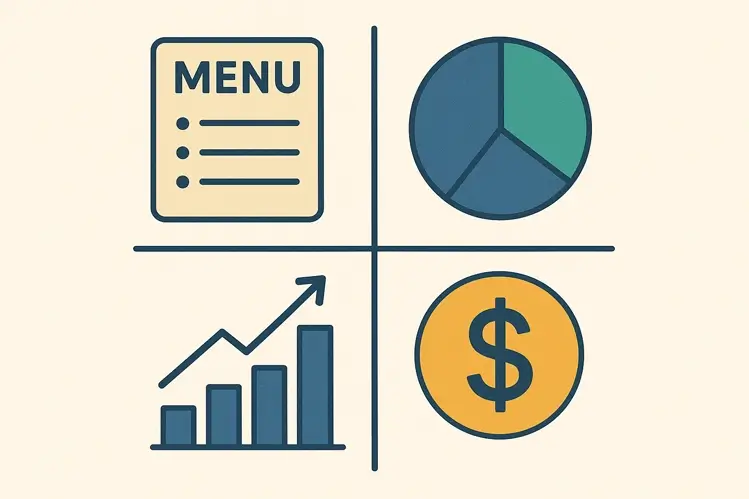
The first step is to categorize every dish based on two simple metrics: its popularity (how well it sells) and its profitability (its contribution margin). This places each item into one of four easy-to-understand categories:
The Best Sellers (High Profit):
These are your home-run dishes. Customers love them, and they deliver a fantastic profit margin. Think of them as your menu’s celebrities, like a perfectly executed Dal Makhani that everyone raves about. The goal for these items is to promote them heavily, ensure you never run out, and protect their recipe and quality above all else.
The Popular but Low-Profit Items (High Popularity, Low Profitability):
These are your Mass-Pleasers. They are beloved by customers but are a drain on your overall menu profit margin. A classic example in India is a Chicken Biryani or a Rajma Chawal. They sell in high volume, but due to ingredient costs and competitive pricing, they don’t make much money. The goal isn’t to remove them but to strategically improve their profitability—perhaps through a slight price adjustment, a portion size review, or a cost-saving ingredient swap that doesn’t affect quality.
The Hidden Gems (Low Popularity, High Profitability):
These are the undiscovered treasures of your kitchen. They are highly profitable but, for some reason, aren’t discovered by your guests. This could be a unique regional dish or a special dessert. The goal for these Hidden Gems is to make them more popular through strategic placement on the menu, better descriptions, or staff recommendations.
The Underperformers (Low Popularity, Low Profitability):
Let’s be honest: every menu has them. These items don’t sell well and aren’t profitable. They complicate your inventory, take up space, and slow down the kitchen. The goal for these Underperformers is simple: remove them from the menu entirely.
How to Conduct Your Own Menu Engineering Analysis
Ready to see where your dishes fall? Here’s a step-by-step guide to your own analysis.
1. Calculate Your Food Cost and Contribution Margin:
For each menu item, you need to know its food cost percentage and, more importantly, its contribution margin (selling price minus the cost of the ingredients). This is the true measure of an item’s profitability. If you’re unsure how to do this accurately, resources like this guide on how to calculate and control restaurant food cost percentage can be incredibly helpful.
2. Analyze Your Sales Data:
Pull reports from your POS system or your billing software for the last 3-4 months. Calculate each item’s percentage of total sales. What is your average popularity? Any item selling significantly above that average is “high popularity.”
3. Plot Your Items on the Matrix:
Create a simple four-quadrant graph. The vertical axis represents profitability (contribution margin), and the horizontal axis represents popularity (sales mix percentage). Plot each dish. Your Best Sellers will be in the top-right, Popular but Low-Profit Items in the bottom-right, Hidden Gems in the top-left, and Underperformers in the bottom-left quadrant.
Menu Psychology and Design: The Invisible Art of Influence

This is where the magic happens. Once you know what each item is, you can use principles of menu psychology and design to influence customer behaviour naturally.
- The Golden Triangle: Research shows that a customer’s eyes typically move to the top-right corner of a menu first, then to the centre, and finally to the top-left—forming a “Golden Triangle.” This is the prime real estate where you should feature your Best Sellers and Hidden Gems.
- Strategic Menu Layout and Zones:
Use design elements like boxes, borders, or subtle shading to create “action zones” that draw the eye. Placing a high-profit item in a well-designed box can increase its sales significantly. This is a key area where the expertise of restaurant design professionals can make a tangible impact on profits. - The Power of Descriptive Language:
Compare “Gulab Jamun” to “Soft, Warm Gulab Jamuns soaked in Fragrant Rose and Cardamom Syrup.” Which one would you order? Evocative, sensory language sells the experience, not just the ingredient, and is perfect for boosting sales of your Hidden Gems. - Pricing Psychology:
Small tricks can make a big difference. Consider removing full price to reduce the pain of paying. Use charm pricing (e.g., ₹495 instead of ₹500). You can also use an anchor—a high-priced item next to a target dish—to make the target seem more reasonably priced.
Putting It All Together: From Analysis to Action
Menu engineering isn’t a one-time project; it’s an ongoing process. Here’s your action plan:
- Analyse: Categorize every item on your current menu.
- Edit: Be ruthless and remove the “Underperformers.”
- Optimize: Adjust prices or recipes for “Popular but Low-Profit Items.”
- Design: Highlight your “Best Sellers” and “Hidden Gems” using the principles of menu design and psychology.
- Train: Ensure your serving staff understands the new menu and is prepared to recommend your high-profit items.
Conclusion: Your Menu is Your Silent Salesperson
Your menu works every single second your restaurant is open. By applying the principles of menu engineering, you transform it from a passive list into an active, powerful tool for boosting your bottom line. It’s a continuous cycle of testing, learning, and optimizing.
While any owner can start this journey, mastering the delicate balance between data, menu psychology, and beautiful restaurant menu design often requires an expert touch. This is precisely the kind of strategic support a dedicated restaurant consultant provides.
If you’re looking to truly engineer your menu for maximum profit, consider partnering with experts. The team at Kriaan offers specialized restaurant consultants services that blend analytical rigor with design excellence to create menus that look beautiful and perform brilliantly.
Ready to transform your menu? Explore our restaurant consultancy services to learn how we can help you achieve lasting profitability.
What’s the biggest challenge you’ve faced with your menu? Share your thoughts below!
FAQ: Menu Engineering for Restaurants
Q1: How often should I re-engineer my menu?
A: It’s best practice to conduct a minor review every 3-4 months (quarterly) and a major overhaul every 6-12 months. This allows you to account for seasonal ingredient price changes, shifting customer preferences, and new food trends. Regular analysis ensures your menu remains consistently profitable.
Q2: Is menu engineering only for large, fancy restaurants?
A: Absolutely not! This strategy is perhaps even more critical for small and mid-sized restaurants and cafes. Every rupee of profit counts. Menu engineering provides a clear framework to make smart, data-driven decisions that directly boost your bottom line, regardless of your restaurant’s size or style.
Q3: I don’t have a high-tech POS system. Can I still do this?
A: Yes, you can. While a POS system automates sales tracking, you can start manually. Keep a careful record of which dishes are ordered each day (your “kOT sheets” or billing copies are perfect for this). Track this for a few weeks to get a reliable idea of each dish’s popularity. For cost calculation, use your purchase invoices—this is how it was done for decades, and it still works!
Q4: Won’t customers get upset if I remove their favourite dish, even if it’s an “Underperformer”?
A: This is a common concern. The key is strategy. First, you can try to improve the dish’s profitability before outright removing it. If removal is necessary, consider introducing a “special” or a “chef’s recommendation” to replace it. Most customers are open to trying new things, especially if they are presented well. If a dish is truly a unique signature item loved by regulars, it might be worth keeping for overall customer satisfaction, even if its profits are low.
Q5: How can a restaurant consultant in Delhi help with this process?
A: A professional restaurant consultant brings expertise and an objective eye. They can:
- Conduct a precise profitability analysis without the emotional attachment you might have to certain dishes.
- Apply advanced principles of menu psychology and design to strategically highlight high-profit items.
- Train your staff on how to effectively upsell and recommend these items.
- Provide insights into local Delhi-NCR market trends and customer preferences. Partnering with experts like Kriaan can streamline the process and ensure you get the maximum return on investment from your new menu.
Q6: Can menu engineering really make a big difference to my profits?
A: Yes, consistently. Studies and industry reports show that effectively applying menu engineering principles can increase overall restaurant profits by 10-15% without any change in footfall or food cost. It is one of the most powerful and cost-effective tools a restaurateur has to improve profitability.