

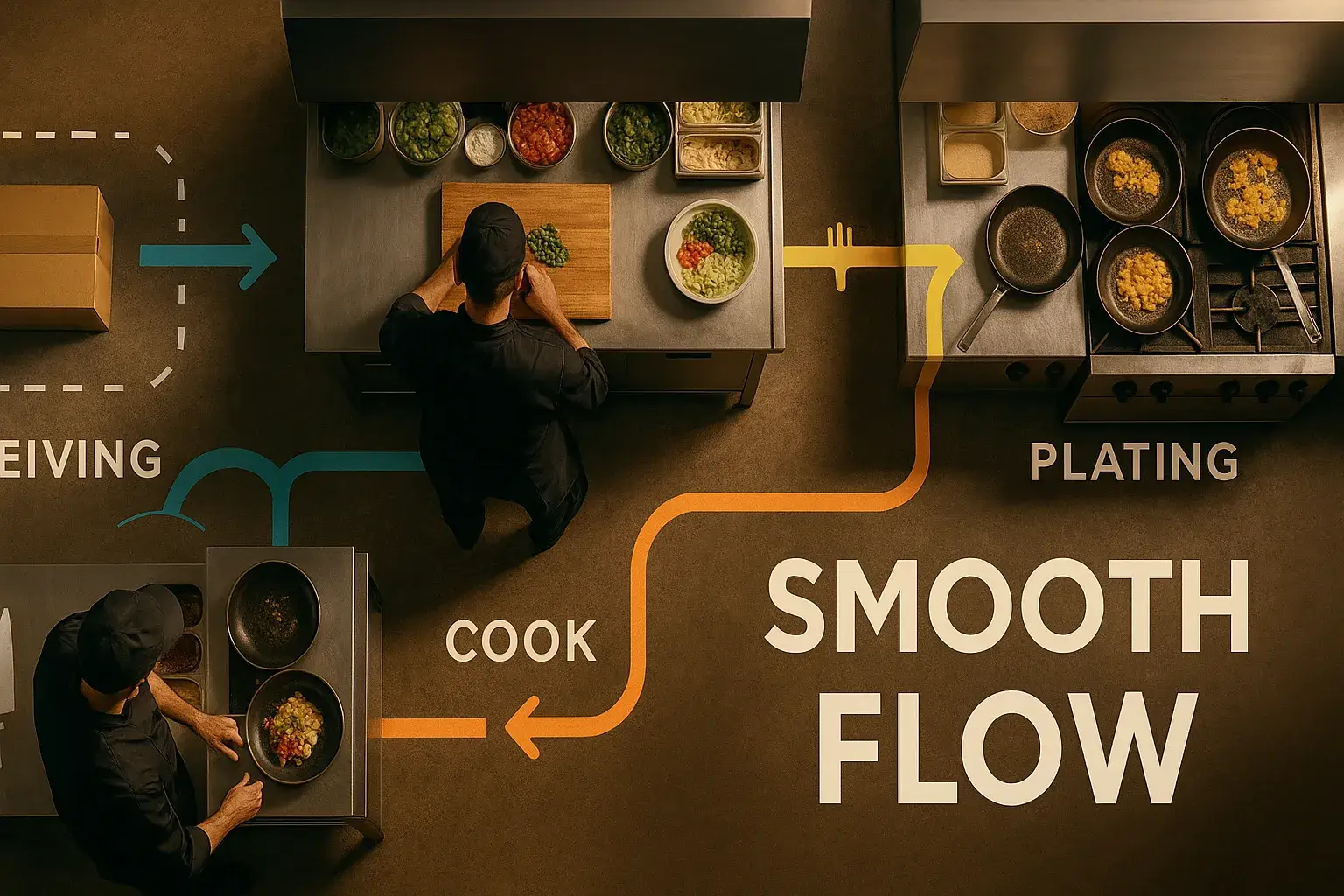
If you’ve ever had to apologize for a delay because the appetizers were ready but the main course was stuck in a bottleneck, you’ve felt the cost of poor kitchen workflow. In my experience consulting for Delhi restaurants, I’ve seen head chefs logging over on a single Saturday shift—just moving between stations. That’s wasted energy and time you’re paying for.
While passion and recipes are vital, a well-planned kitchen is the operational engine that determines profitability. A strategic redesign can typically reduce order fulfilment time by 15-30% by simply eliminating unnecessary movement.
Why Kitchen Workflow Impacts Your Bottom Line
The connection between spatial planning and profitability is often underestimated. Poor workflow doesn’t just cause stress—it directly impacts costs:
Labor Costs: When staff take extra steps to complete basic tasks, you’re paying for wasted motion
Food Waste: Inefficient layouts lead to spoilage and errors—one client reduced dairy waste by 20% simply by relocating their refrigerator
Customer Experience: Slow service during peak hours can damage your reputation
Core Principles of Effective Kitchen Design
The Zone Strategy: Beyond the Basic Triangle
In my view, zoning is the single most overlooked factor in independent restaurant kitchens. Rather than the residential “work triangle” think in terms of dedicated zones:
Real-world example: We worked with a North Indian restaurant in Rajouri Garden where the tandoor was located at the back of the kitchen. By creating a dedicated Tandoor Zone with its own plating station, they reduced ticket times by 7 minutes.
Key zones to establish:
- Receiving & Storage (near delivery entrance)
- Preparation (positioned between storage and cooking)
- Cooking (group equipment by heat source/function)
- Assembly (the critical bridge between cooking and service)
- Cleaning (separate but accessible)
The Linear Flow Principle
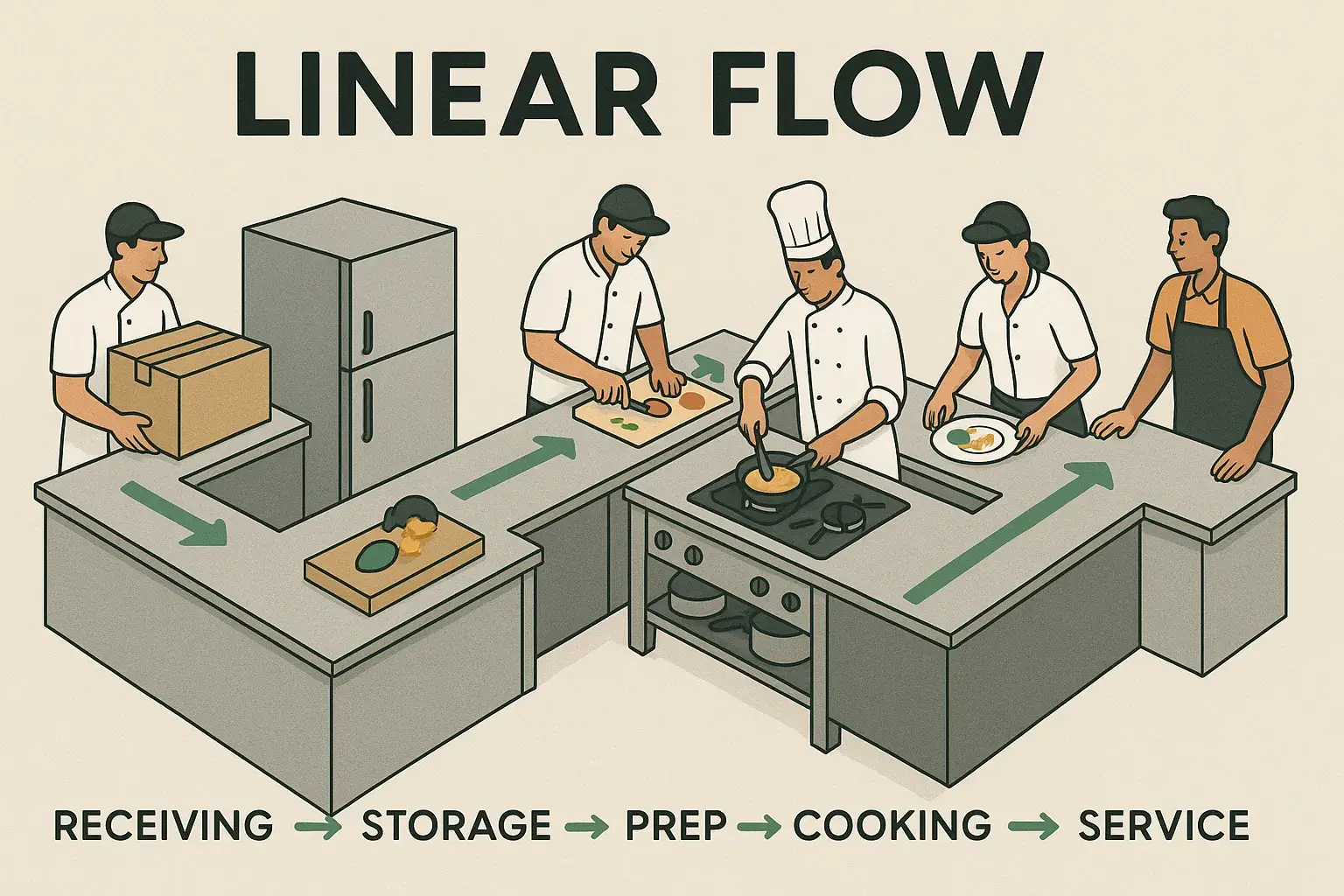
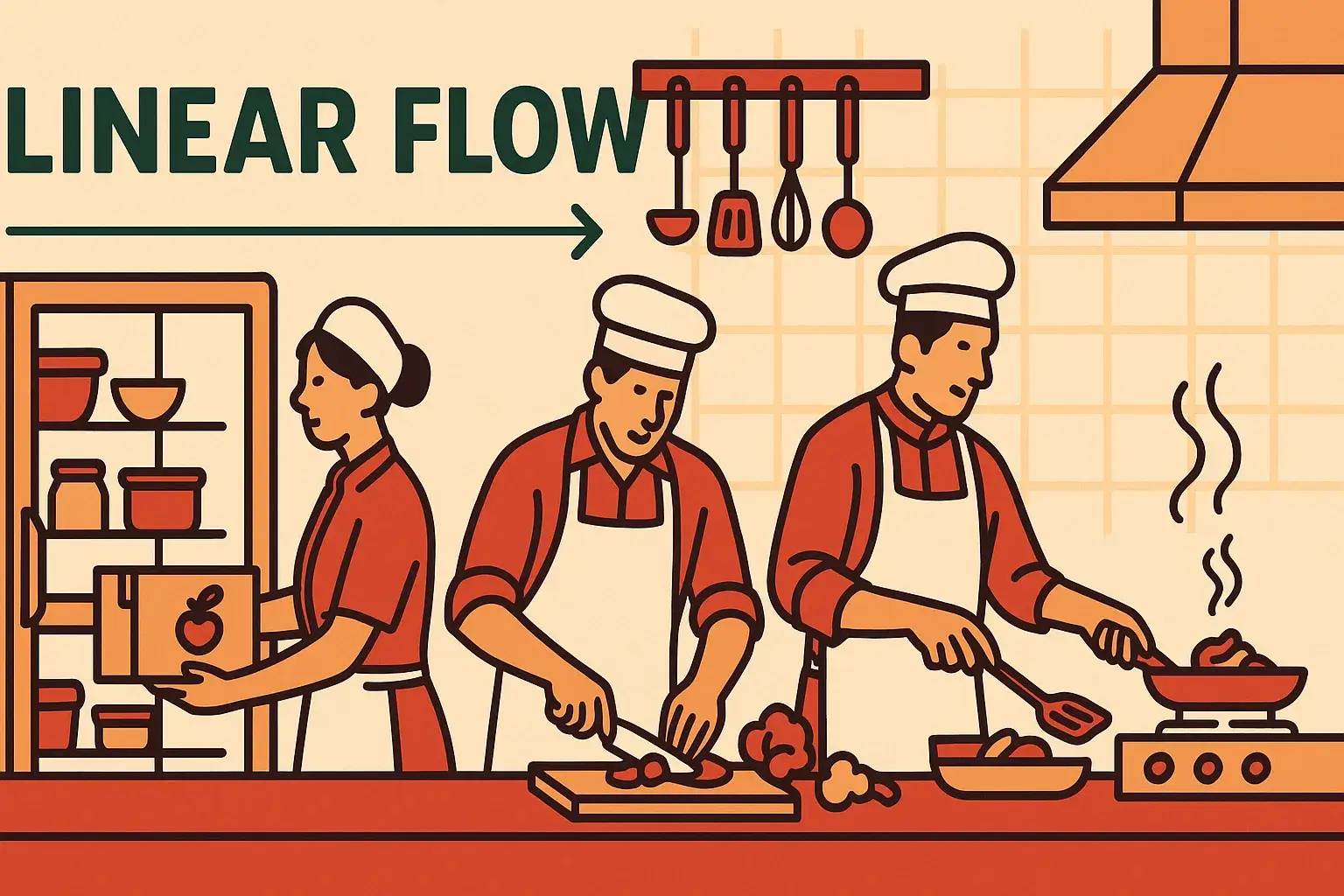
Food should move in one primary direction: from receiving → storage → prep → cooking → plating → service. Backtracking isn’t just inefficient—it increases contamination risks and staff frustration.
Step-by-Step: Analysing Your Current Workflow
Here’s a practical approach any owner can implement this week:
1. Map Your Current Layout
– Sketch your kitchen floor plan (paper is fine)
– Track the path of your 3 most popular dishes from start to finish
2. Identify Bottlenecks
– Where do staff consistently collide or wait?
– Which equipment causes congestion?
– Where does inventory get “stuck”?
3. Implement Targeted Solutions
– Sometimes small changes yield big results—one cafe saved roughly around ₹8,000/week by simply adding an under-counter fridge at their coffee station
The Waste Reduction Connection
A well-designed workflow naturally reduces waste through:
– Better Inventory Management: When storage flows logically into prep areas, FIFO (First-In, First-Out) becomes easier to maintain
– Reduced Errors: Calm, organized spaces lead to better portion control and fewer mistakes
– Improved Yield: Proper station setup means less spillage and better ingredient utilization
Real Results: Case Examples
Case 1: The Bottlenecked Tandoor
– Problem: A family-run restaurant in Firozabad struggled with 45-minute ticket times during lunch rush
– Action: We created a dedicated Tandoor Zone with integrated plating
– Result: Ticket times dropped to 30 minutes, increasing lunch covers by 15%
Case 2: The Dairy Waste Issue
– Problem: In Dwarka A high-volume cafe was losing average ₹8,000/week in spoiled milk
– Action: Installed point-of-use refrigeration and new restocking procedures
– Result: Dairy waste reduced by 20% within first month
Your 6-Step Action Plan
1. Time Your Flow: Use a stopwatch during next Friday’s service—track one dish from order to pass
2. Sketch Your Layout: Draw your kitchen and mark major traffic patterns
3. Interview Your Chef: Ask “What’s the one physical change that would make your job easier?”
4. Audit Waste: For one week, track what gets thrown out and why
5. Declutter: Clear one countertop completely—only return essential items
6. Consider Professional Input: A few hours of consultant time can prevent costly renovation mistakes
FAQ
Q1. What’s the first step to improving our kitchen workflow?
Ans. Start with observation. Spend 30 minutes during your next busy service simply watching movement patterns. Look for crossing paths, waiting points, and unnecessary steps. For a formal assessment, most consultants offer a 2–3-hour kitchen audit starting around ₹15,000-₹25,000.
Q2. How much can we realistically save with better workflow?
Ans. Results vary, but typical improvements include 15-30% faster service times, 10-20% reduction in labor costs during peak hours, and 5-15% reduction in food waste. The biggest gains often come from simple, low-cost adjustments rather than full renovations.
Ready to transform your kitchen’s efficiency? Explore our restaurant consulting services for a customized workflow analysis.