

The dream of opening a restaurant is a powerful one. It’s a vision of a bustling dining room, the clinking of glasses, the aroma of incredible food, and the joy of creating a community hub. However, the harsh reality of the hospitality industry often shatters this dream. Statistics are showing: a significant number of restaurants fail within their first two years. The reasons are often a complex mix of undercapitalization, poor location, inconsistent quality, inefficient operations, and simply not understanding the target market.
So, the big question is, how do successful restaurateurs? Many don’t do it alone. Behind the scenes of many thriving eateries is a secret weapon: the restaurant consultants. This complete guide will demonstrate the role of these industry experts, exploring what they do, why they are so valuable, and how they can be the difference between a restaurant that flourishes and one that becomes just another statistic.
Who Are Restaurant Consultants?
At their core, restaurant consultants are professional advisors who provide expert guidance and actionable solutions to restaurant businesses. They are seasoned veterans of the food and beverage industry, bringing a wealth of experience from operations, management, finance, marketing, and culinary arts. They act as an objective third party, diagnosing problems and implementing strategies that owners, who are often too emotionally invested or busy with day-to-day fires, might miss.
It’s important to understand that “restaurant consultant” is a broad term. Many consultants specialize in specific areas:
- Startup Consultants: Those who Guides for new restaurateurs, helping with everything from concept creation to the grand opening.
- Operations Consultants: Efficiency experts who streamline kitchen workflows, manage inventory, and optimize staff scheduling.
- Branding & Marketing Consultants: Specialists who craft a restaurant’s identity, develop its story, and execute strategies to attract and retain customers.
- F&B (Food & Beverage) Consultants: Focus specifically on the menu, from recipe development and costing to sourcing ingredients and beverage program design.
Finally, it’s crucial to distinguish a consultant from other roles. A consultant advises and implements systems; a restaurant manager runs the day-to-day operations using those systems. A designer focuses on the aesthetic and functional layout of the space; a restaurant consultant may work with the designer to ensure the layout supports efficient service and profitability.
Key Roles of Restaurant Consultants
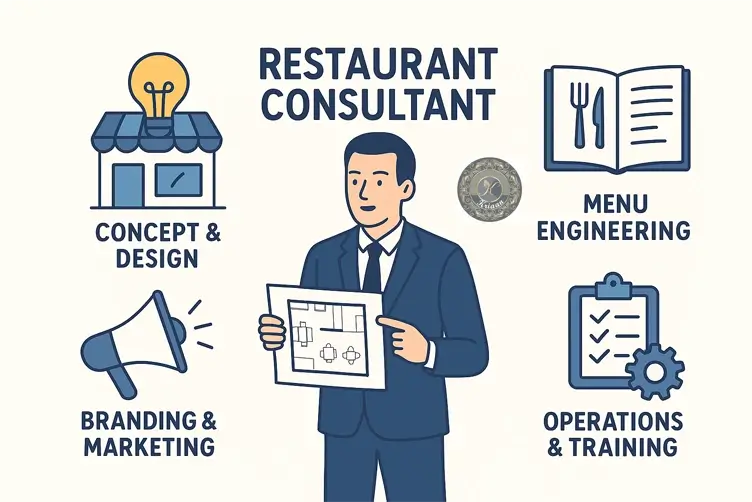
The work of a restaurant consultant is multifaceted. They can be involved in every single aspect of the business, often wearing many hats to ensure all pieces fit together seamlessly.
1. Concept & Ideation
A restaurant without a clear concept is like a ship without a rudder. Restaurant Consultants help owners refine their vision into a unique, marketable idea. They ask the critical questions: Who is your customer? What story are you telling? What is your unique value proposition? Whether it’s a farm-to-table bistro, a high-energy neon-drenched ramen bar, or a cozy neighbourhood café, the consultant helps shape this idea into a cohesive and financially viable concept.
2. Market Research & Feasibility Study
A great idea in the wrong location is supposed to fail. Restaurants Consultants conduct thorough market analysis to assess the viability of a concept in a specific area. They study demographics, analyse foot traffic, identify direct and indirect competitors, and gauge local dining trends. This data-driven approach helps in making informed decisions about location, pricing, and menu offerings before a single rupee is spent on rent or renovation.
3. Financial Planning & Budgeting
Many restaurateurs are passionate about food but may lack financial expertise. Consultants bring fiscal discipline. They help create detailed business plans and financial models, projecting revenue, forecasting expenses, and determining startup capital requirements. They guide investment allocation, advise on cost-control measures (like food cost percentage and labour cost), and develop strategic pricing models to ensure healthy profit margins.
4. Menu Engineering & Food Strategy
The menu is the heart of the restaurant, and it’s much more than a list of dishes. Menu engineering is a science. Restaurant Consultants analyse the profitability and popularity of each item, strategically designing the menu layout to guide customer choices towards high-margin “stars.” They help with portion sizing, recipe costing, sourcing strategies, and even the psychological aspects of pricing (e.g., avoiding round numbers like ₹200 in favor of ₹199). This directly and dramatically impacts the bottom line.
5. Branding & Marketing
In today’s digital age, a restaurant must have a strong brand and online presence. Restaurant Consultants assist in developing the restaurant’s entire identity—its name, logo, brand voice, and overall aesthetic. They craft pre-launch marketing campaigns to generate buzz and develop ongoing strategies for social media, online reviews (like Google and Zomato), email marketing, and local SEO to ensure the restaurant is easily discovered by hungry patrons.
6. Operational Setup & Workflow
A chaotic kitchen leads to slow service and unhappy customers. Restaurant Consultants are masters of efficiency. They design the back-of-house (BOH) and front-of-house (FOH) workflows for maximum productivity. This includes creating organizational charts, defining staff roles, developing Standard Operating Procedures (SOPs) for every task and establishing relationships with reliable vendors and suppliers.
7. Technology Integration
Modern restaurants run on technology. Restaurant Consultants stay ahead of the latest tech solutions and recommend the right tools for the business. This includes selecting and implementing a Point-of-Sale (POS) system, setting up online ordering and delivery integrations, deploying a Customer Relationship Management (CRM) system to build loyalty, and using inventory management software to reduce waste and prevent theft.
Responsibilities of a Restaurant Consultant
Beyond their key roles, restaurant consultants take on several critical responsibilities:
- Strategic Advisor: They are the trusted guide, providing a clear roadmap from concept to launch and beyond, offering objective advice at every critical juncture.
- Problem Solver: They are brought in to diagnose and fix specific issues, whether it’s mysteriously high food costs, consistently low table turnover, poor online ratings, or high staff turnover.
- Trainer & Mentor: They don’t just create systems; they teach the team how to use them. This involves training staff on service standards, mentoring managers on leadership, and coaching chefs on cost control.
- Compliance & Licensing Support: Navigating the web of health codes, safety regulations, liquor licenses, and other legal requirements can be a nightmare. Restaurant Consultants help ensure the business is fully compliant, avoiding costly fines or shutdowns.
- Growth Partner: For established businesses, consultants help plan the next chapter. They assist with scaling operations, launching a second location, or even developing a franchise model.
Why Are Restaurant Consultants So Important?
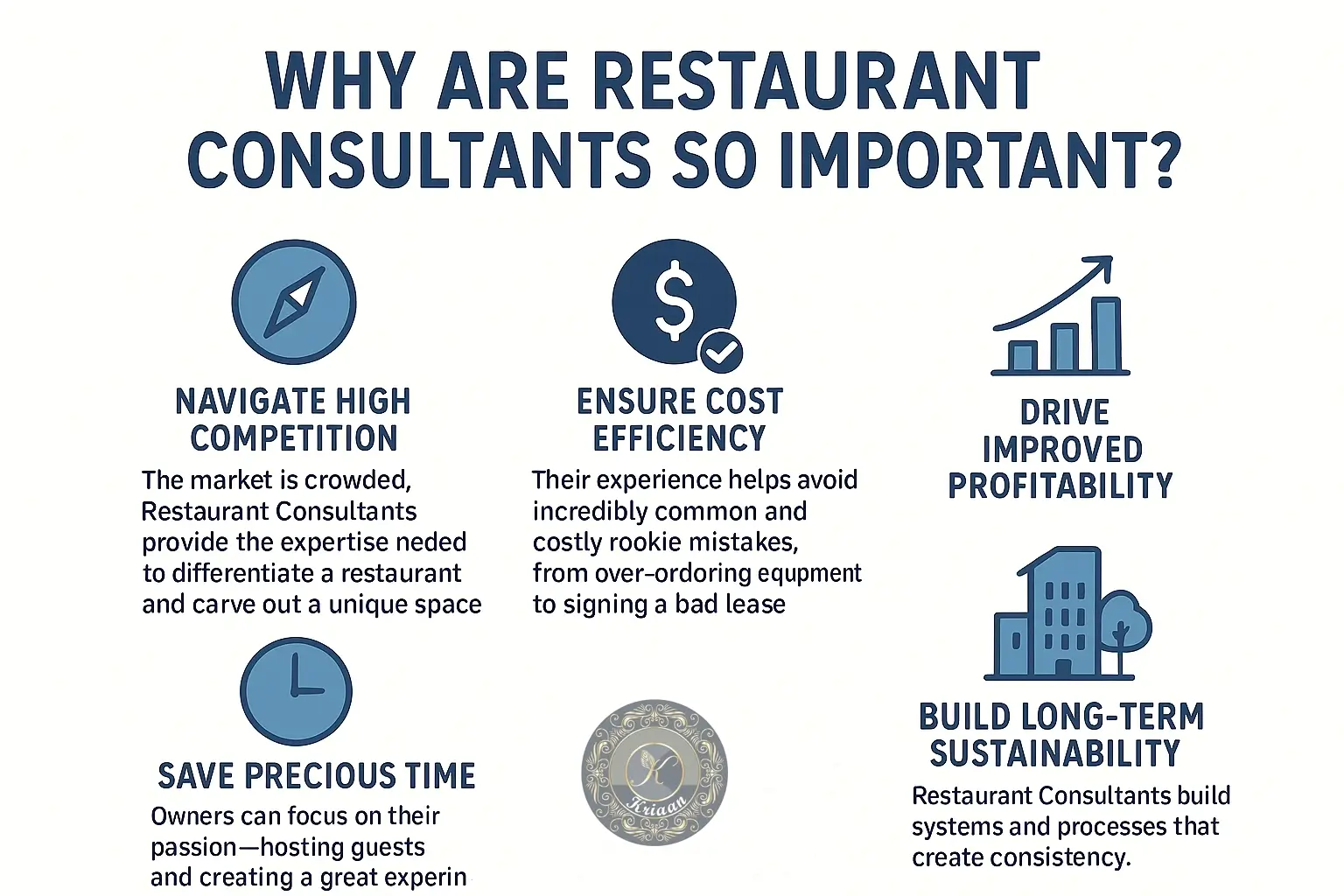
Hiring a restaurant consultant is an investment, but one that often pays for itself many times over.
- Navigate High Competition: The market is crowded. Restaurant Consultants provide the expertise needed to differentiate a restaurant and carve out a unique space.
- Ensure Cost Efficiency: Their experience helps avoid incredibly common and costly rookie mistakes, from over-ordering equipment to signing a bad lease.
- Drive Improved Profitability: Through menu engineering, operational tweaks, and effective marketing, they directly implement strategies that boost revenue and reduce unnecessary expenses.
- Save Precious Time: Owners can focus on their passion—hosting guests and creating a great experience—while the restaurant consultant handles the complex, time-consuming setup and strategic work.
- Build Long-Term Sustainability: Restaurant Consultants build systems and processes that create consistency. This consistency is what turns a new restaurant into a beloved, enduring institution.
When Should You Hire a Restaurant Consultant?
You don’t need to be a massive chain to benefit from a restaurant consultant. They can be invaluable at any stage:
- When Starting a New Restaurant: This is the most crucial time. Getting the foundation right from day one is infinitely easier than fixing problems later.
- When Struggling with Low Sales or High Expenses: If you’re open but not profitable, a consultant can perform a “business health check” and prescribe a turnaround plan.
- When Rebranding or Repositioning: If your concept needs a refresh to stay relevant, a consultant can help pivot effectively.
- When Planning to Scale or Franchise: They can create the reproducible systems and processes needed for successful expansion.
- When Facing Operational or Staffing Challenges: Chronic issues with service speed, food quality, or staff morale can often be solved with an expert’s perspective.
Case Example: A Turnaround Story
Consider the case of “RAAG RESTAURANT & CAFE HALDWANI” a trendy café in Haldwani. Despite a great location, it was struggling with low footfall and negative reviews about slow service and an “overpriced” menu. The owner brought in a restaurant consultant who conducted a full audit. The consultant:
- Redesigned the Menu: Streamlined the overly ambitious offering, focused on high-margin signature items, and re-priced dishes using psychological pricing.
- Trained the Staff: Implemented a new floor plan and service protocol, reducing average wait time for orders by 40%.
- Revamped Branding: Launched a targeted social media campaign highlighting their premium, ethically sourced coffee beans and instagrammable food, justifying the pricing and attracting a new audience.
Within three months, online ratings improved from 3.2 to 4.5 stars, and sales grew by an impressive 35%. The restaurant consultant’s external perspective and structured approach identified and solved problems the owner was too close to see.
For Instant Query Call us at : +91 8588 999 885 / 999 999 3775 — Or — Email us at : [email protected]
Conclusion
A restaurant consultant is far more than just an advisor; they are a strategist, a problem-solver, a trainer, and a partner invested in your success. From the initial spark of an idea to the complexities of daily operations and long-term growth, they provide the expertise and framework that can help transform a passionate dream into a profitable and sustainable reality.
If you are planning to launch a new restaurant or want to revitalize your existing business, partnering with an experienced restaurant consultants, who can provide the clarity and direction you need to thrive in the competitive food and beverage industry.
FAQ Section
Q: What is the primary role of a restaurant consultant?
A: Their primary role is to provide expert, objective advice and implement practical solutions to improve a restaurant’s concept, operations, profitability, and long-term sustainability. They act as strategic guides and problem-solvers.
Q: How much do restaurant consultants charge in India?
A: Fees can vary widely based on experience, the scope of work, and the project’s size. Some consultants charge a fixed project fee, others a monthly retainer, and some may work on a performance-based model. Initial consultations are often offered for free or at a minimal cost.
Q: Do small cafés or single-location restaurants need consultants, or is it only for large chains?
A: Absolutely! Small independent restaurants and cafés often benefit the most. They typically have tighter budgets and less margin for error. A consultant can help them avoid costly mistakes and compete effectively with larger, more established brands, making the investment incredibly valuable.
Q: What’s the key difference between a restaurant consultant and a restaurant manager?
A: A consultant is typically an external expert hired for a specific project or period to analyse, advise, and implement new systems and strategies. A manager is an internal, full-time employee responsible for the day-to-day execution of those systems, managing staff, and ensuring smooth daily operations. The consultant builds the roadmap; the manager drives the car on a daily basis.